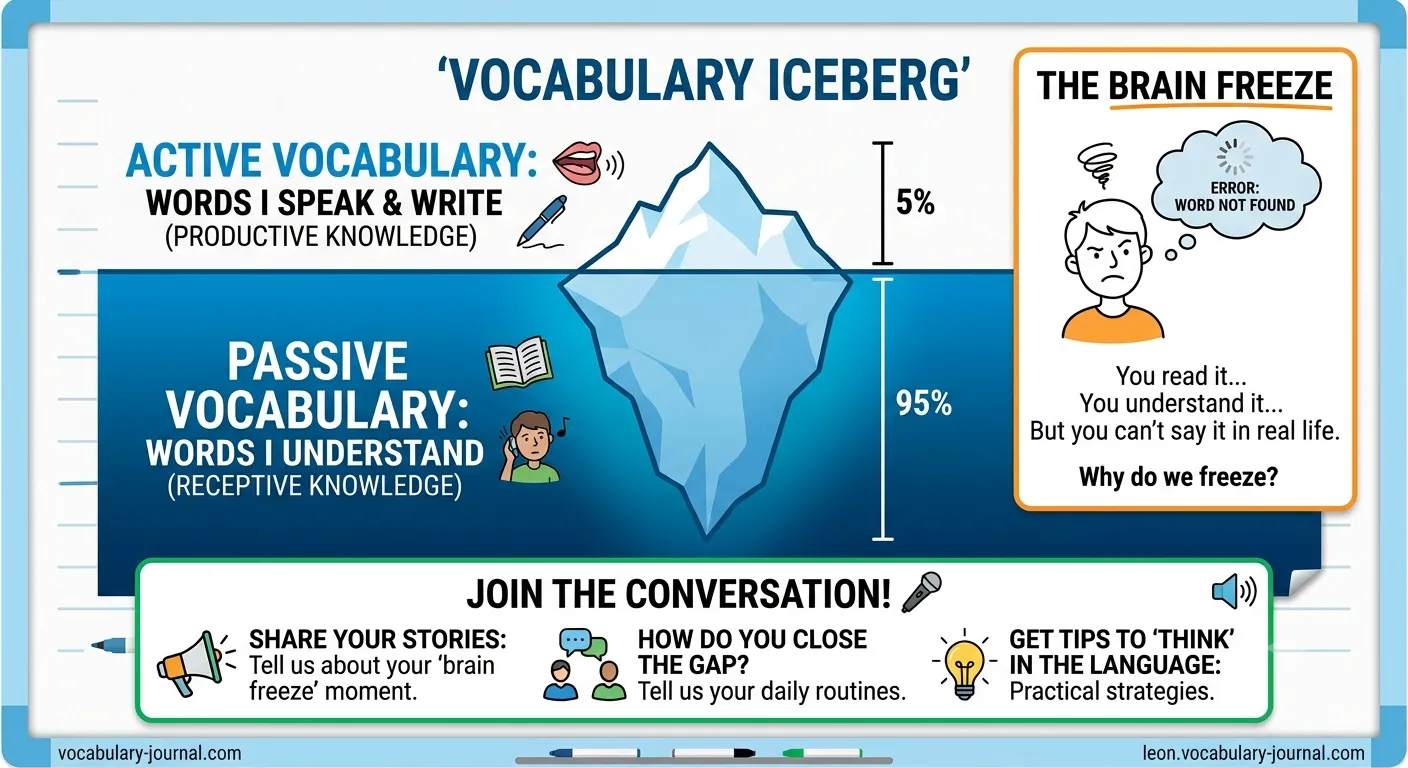
Somewhere between the moment we understand a word and the moment we can use it naturally, a gap appears. That gap is the difference between passive vocabulary and active vocabulary.
This is the idea behind the “Vocabulary Iceberg”:
- The large part under the water is the vocabulary we recognize when we read or hear it.
- The tiny tip above the water is the language we can actually retrieve and use in real time.
For many learners, this feels surprisingly familiar. We understand a word perfectly in context, yet when we try to speak, the word disappears.
Why this happens
I was talking with a learner from Indonesia in my weekly HelloTalk voice room recently, and she described the feeling perfectly. She said she often knows the word she needs, but it never shows up when she is speaking.
She was doing exactly what many of us do: she was chatting in English a few times a week. That is helpful, but it also comes with a limitation.
Casual conversation is usually built on familiar, high-frequency words. It helps us communicate, but it does not necessarily stretch the vocabulary we need to express nuance, precision, or depth.
This is why language learning often feels like a trap:
- We read and listen a lot.
- We understand more than we can use.
- We feel stuck when speaking, even though we are “making progress.”
The problem is not a lack of intelligence or effort. It is a gap between recognition and active retrieval.
The real fix is not more random chatting
I told her the solution was not to chat more in the same way. The solution was to practice with a clear purpose.
That is where the idea of “narrow writing” comes in.
A lot of language learners know about narrow reading: reading many texts on the same topic to absorb vocabulary naturally. I think the same principle can apply to output.
Instead of writing random journal entries, we can write about a specific topic repeatedly until the language becomes familiar and usable.
Here is the method:
- Notice the moment you freeze.
- Write down the thought you were trying to say.
- Look up the exact words you needed.
- Rewrite the sentence in the way you wanted to express it.
- Repeat it in a few similar situations.
This is powerful because it turns vague gaps into concrete language repair.
From passive to active vocabulary
The goal is not just to understand a word. The goal is to make it available under pressure.
When we repeatedly record the words we lost in real conversation and then rewrite the sentence we wanted, the word moves from passive memory to active memory.
That is the key shift:
- Passive vocabulary = I understand it.
- Active vocabulary = I can retrieve it and use it when I need it.
This is what creates fluency. Not just recognition, but readiness.
Why this matters for real communication
If we only rely on informal conversation, we are mostly practicing the easiest layer of language. We may become comfortable, but we do not necessarily become precise.
Real communication needs more than simple words. We need the vocabulary that helps us:
- explain a subtle idea,
- describe a feeling with more nuance,
- hold a deeper conversation,
- speak with confidence under pressure.
That requires practice that is specific, repeated, and connected to real moments of breakdown.
Why we need tools built around real language problems
This is one of the reasons I am building vocabulary-journal.com.
Every day, learners hit a wall. They forget a word in the middle of a conversation, or they cannot say exactly what they mean. But most tools do not help them save those moments in a useful way.
The missing piece is context.
When a word gets lost in a real-life situation, the memory is attached to:
- the emotion of the moment,
- the conversation topic,
- the exact idea you were trying to express,
- the phrase you needed but could not retrieve.
If we want vocabulary to stick, we need to save that whole context, not just a random word in isolation.
A practical question to ask yourself
The next time you freeze in speaking, ask:
- What was I trying to say?
- What word or phrase did I need?
- What sentence would I use next time?
That one question can create a huge shift in your language learning.
Because the goal is not to become perfect. The goal is to become more ready.
And the more often we practice those exact moments of failure, the less often they will happen.
Do you want to stop freezing during conversations and actually use more of your vocabulary? That is the real challenge language learners face—and it is also the reason this work matters.
P.S. What is the last word that made you freeze in a conversation? I would love to hear about it.